THE HARTBEESPOORT DAM IN CRISIS: ECOLOGICAL DETERIORATION AND INSTITUTIONAL FAILURE IN SOUTH AFRICA
Cristiana Harless, Ilias Tzanetoulakos, Martina Guerrero, OSINT-RDT Team
Alessandro Portolano, Editor; Jennifer Loy, Chief Editor
April 26, 2026

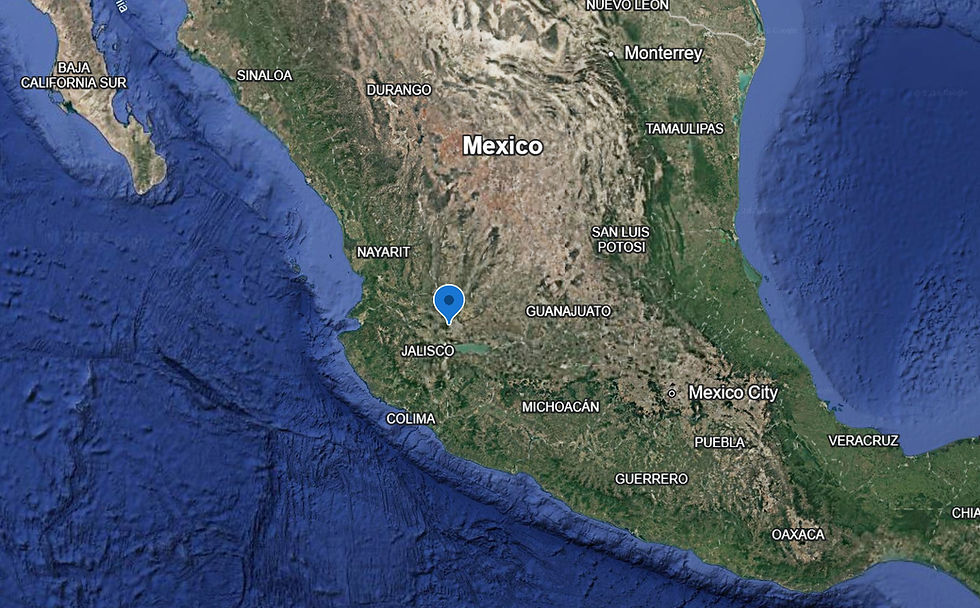
Hartbeespoort Dam, Hartbeespoort, North West Province of South Africa[1]
Key judgments
Persistent pollution of the Hartbeespoort Dam mainly stems from repeated institutional and political failures. Unenforced legislation, misguided interventions, and fragmented decisionmaking has led to decades of neglect despite abundant scientific documentation of environmental concern. Since 1970, poor wastewater infrastructure have exacerbated chronic phosphorus pollution from agricultural run-off, contributing to algal blooms that suffocate aquatic ecology. These conditions made it one of the most degraded reservoirs in Africa.[2] In April 2023, the Department of Water and Sanitation (DWS) launched a three-year rehabilitation project to improve the dam’s environmental condition, which will likely reduce the threat to public health and ecological collapse in neighboring communities.[3] Yet the project’s success will remain limited so long as the underlying environmental causes and governance failures contributing to the damage are not addressed. This institutional neglect appears to highlight a national water security concern that goes beyond the isolated crisis affecting Hartbeespoort alone, given that South Africa ranks among the 30 most water-scarce countries in the world and relies on dams for approximately 75% of its available surface water. This study analyzes the progression and spread of algal blooms and the deterioration of water quality in Hartbeespoort Dam between 2020 and 2025. The team analyzed the area using geospatial intelligence (GEOINT) tools, such as Google Earth, combined with secondary sources, providing a clear picture of the spatial reach of the pollution and the institutional failure to address it.
The Hartbeespoort Dam Crisis: Ecological Deterioration and Institutional Failure in South Africa
Region and focus of the study: This study analyzes the chronic pollution at Hartbeespoort Dam, located in the North West Province of South Africa, about 35 km west of Pretoria. Neighboring communities reliant on the reservoir for tourism, economic activity, and recreation include Kosmos, Melodie, Ifafi, Meerhof, Pecanwood, and The Coves.[4] Although the 2023 rehabilitation project gained superficial improvements, the dam’s long-term recovery will likely depend on South Africa’s ability to overcome the institutional and political failures that have allowed polluters to freely operate for decades.
Investigative Focus: The Hartbeespoort Dam is a historically important reservoir that serves as a hub for tourism, recreation, and agriculture for the surrounding communities. Its main source of water is the Krokodilriver (Crocodile River), which flows through farmland and golf courses. Agricultural run-off flows into the Crocodile River, carrying and then discharging nutrient-rich fertilizers into the dam. Simultaneously, Johannesburg’s Zandspruit wastewater pumping station discharges untreated wastewater into the Jukskei River, which in turn flows through the Crocodile River and subsequently into the reservoir.[5] Google Earth imagery from 2020 to 2022 shows extensive algal blooms, corresponding to regulatory failures despite decades of scientific warnings. Following the 2023 remediation program, a new review of satellite images from 2023 to 2025 reveals an improvement in water hyacinth coverage,[6] but the mass fish die-off of 2025 suggests continued ecological degradation.[7]
Affected Points:

Hartbeespoort Dam, May 30, 2020[8]
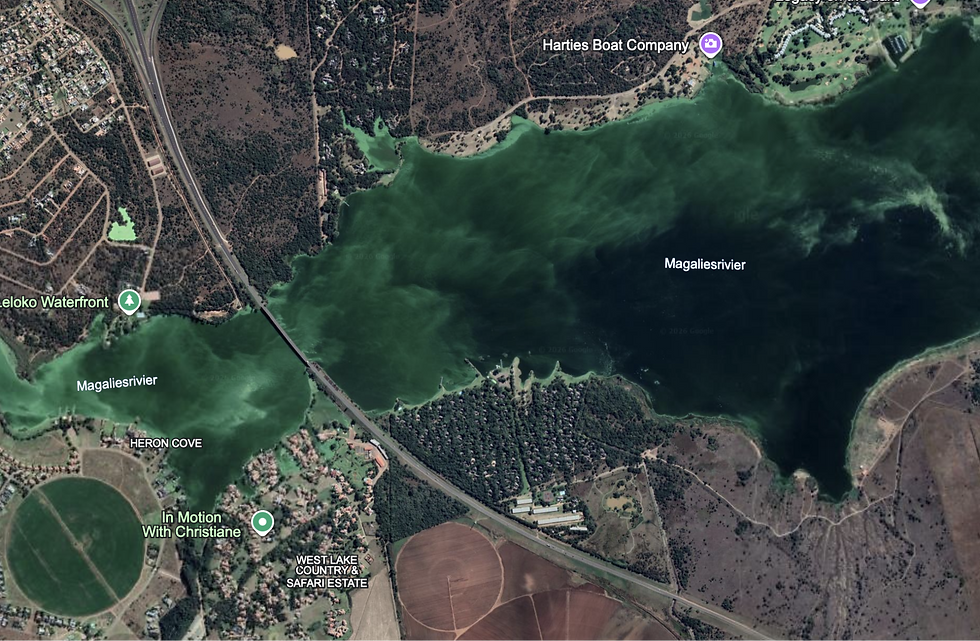
Hartbeespoort Dam May 30, 2021[9]

Hartbeespoort Dam, October 30, 2022 [10]

Hartbeespoort Dam, January 30, 2023[11]

Hartbeespoort Dam, May 31, 2024[12]

Hartbeespoort Dam, March 30, 2025[13]
Pattern between affected points:
Terrain Changes: Algae in the Hartbeesport Dam is visible on the water’s surface in Google Earth imagery from 2020 to 2025. The growth of green algae flowing from the Crocodile River, visible in the 2020 imagery, and the outflow of water into the Magalies River, as seen in the 2021 imagery, indicate that the reservoir's water quality is degrading and spreading to nearby towns. Dense algae is visible in 2022 and the 2023 imagery shows the severity of the situation and the lack of remediation initiative. Visible shrinkage in 2023, 2024, and 2025 imagery suggests improvements in the dam’s water conditions. Compared to the 2022 image, the 2023 image shows a reduction in the hypereutrophication[14] across the dam from around seven km to four km in length of algae covering the water surface. In the 2024 and 2025 images, the algae has cleared significantly.
Operational Changes: Imagery from 2025 reveals a noticeable algae reduction, indicating improved water conditions in Hartbeespoort Dam. Pollution has long restricted water activities like boating, fishing, and sports for both tourists and locals, but these activities are still currently available. Although the latest imagery suggests some progress, algae buildup remains visible in the dam and along the water’s edges.
Secondary sources
As a result of the latest remediation program, Hartbeespoort Dam’s condition will likely keep improving in the near future, but without significant measures to address upstream pollution, the current rehabilitation program will likely only achieve superficial and temporary improvements, leaving the reservoir vulnerable to continued degradation.
Ineffective political institutions that fail to take responsibility for the dam’s environmental degradation will make it unlikely that a solid recovery plan will emerge. Persisting pollution and degradation will likely impact local communities reliant on the reservoir for economic and subsistence activities. The government’s inability to counteract the dam’s degradation will likely reflect a wider, systemic inadequacy to deal with similar problems, likely heavily impacting the region’s drinking water and human security due to the extensive reliance on water reservoirs in South Africa, where dams store about 75 percent of the available water of the country.[15] A 2023 study identified agricultural and commercial use of fertilizer from farms and golf courses that flows into the Hartbeesport via the Crocodile River as the main cause of the algal blooms.[16] Excess nutrients alter the ecosystem’s natural balance, leading to excessive algal growth. As algal blooms die off, they release bacteria that consume oxygen, severely depleting oxygen levels and rendering the aquatic ecosystem less productive by killing fish and other aquatic life.[17] Additionally, during a 2023 inspection, Sello Seitlholo, the DWS Deputy Minister, revealed that 30 million litres of raw sewage were spilling into the dam as a result of malfunctioning infrastructure at the Zandspruit pump station, causing further damage.[18] Following the inspection, a mass fish die-off in April 2023 killed hundreds of large carp due to a lack of oxygen. The water cannot be consumed without proper filtering, and its toxins have caused skin rashes to visitors and sickness to animals that consumed it.[19] Hypereutrophication has afflicted the Hartbeespoort reservoir since the 1970s, though bioremediation programs in the 1990s briefly stymied the ecological degradation. Yet the program’s high cost led to its abandonment, making it the only period with significant documented improvements.[20] Another bioremediation program ran from 2006 to 2016 aimed at mitigating nutrient stocks using biomanipulation, but it proved ineffective: Various studies concluded that the trophic status of the dam was too high for biomanipulation methods to succeed.[21] In April 2023, the DWS appointed the private company, Magalies Water, to implement a holistic program to deal with the invasive algae. The project’s scope included both short-term intervention to physically remove algal excess and a long-term strategy to address underlying hypereutrophication.[22] In April 2026, the DWS published draft regulations on restricting access to the dam, which were heavily opposed by local communities that are financially dependent on it.[23] Satellite imagery shows progress between 2023 and 2025, which is very likely a result of the latest program. However, a second mass fish die-off in October 2025 indicates that water conditions remain abnormal, demanding further action.[24]
The Deputy Minister Seitlholo has called on local municipalities, industrial stakeholders, and businesses to collaborate on reducing pollution.[25] The government also stressed that authorities would hold non-cooperating parties accountable.[26] However, a large portion of local businesses rely on fertilizers conducive to eutrophication, making their ban or reduction unlikely. Evidence also suggests that both private sector and government stakeholders do not consider environmental sustainability as a critical parameter in development planning, leading to increased environmental damage, harming animals and humans.
Conclusion
Due to the remediation program, the Hartbeespoort Dam’s water quality has experienced short-term improvements, but without continuous efforts from DWS, it is likely the dam will continue to decline. The inflow of nutrients from farms and golf courses into the Crocodile River is the main contributor to the growth of algae in the dam. Pollution flowing into the dam and the lack of accountability from political institutions upstream will likely undo short-term successes unless the root causes are not addressed in the longer-term. The algal blooms have been ongoing since the 1970s, and with the government unable to find a solution, the surrounding communities and water reservoirs are likely to be negatively impacted. This study uses GEOINT to examine the growth and reduction of algae in the Hartbeespoort Dam, demonstrating the impact of nutrient-rich fertilizers entering South Africa’s waterways. Consistent monitoring of the dam’s water conditions will enable researchers to track progress more effectively.
[1] Hartbeespoort Dam via Google Earth, created by CTG member
[2] Ibid
[3] Water and Sanitation releases investigation report on cause of fish-kill at Hartbeespoort Dam, South African Government, April 2023
https://www.gov.za/news/media-statements/water-and-sanitation-releases-investigation-report-cause-fish-kill#:~:text=In%20order%20to%20address%20the,Fisheries%20and%20Environment%20(DFFE).&text=Cell:%20060%20561%208935.
[4] Current Effects of Cyanobacteria Toxin in Water Sources and Containers in the Hartbeespoort Dam Area, South Africa, National Library of Medicine, November 2019
[5] 30 million litres of raw sewage flowing into Jukskei River and Hartbeespoort Dam, The CItizen, March 2025, https://www.citizen.co.za/news/south-africa/raw-sewage-jukskei-river-hartbeespoort-dam/
[6] Water hyacinth coverage is an indicator used to measure how much area of a lake, river, or reservoir is covered by Eichhornia crassipes, which is a fast-growing invasive aquatic plant that forms dense floating mats and can significantly disrupt aquatic ecosystems.
[7] Deadly, vivid-green mass sprawls across South African reservoir — Earth from space, Live Science, April 2026, https://www.livescience.com/planet-earth/deadly-vivid-green-mass-sprawls-across-south-african-reservoir-earth-from-space
[8] Hartbeespoort Dam via Google earth
[9] Hartbeespoort Dam via Google Earth
[10] Hartbeespoort Dam via Google Earth, created by CTG member
[11] Hartbeespoort Dam via Google Earth, created by CTG member
[12] Hartbeespoort Dam via Google Earth, created by CTG member
[13] Hartbeespoort Dam via Google Earth, created by CTG member
[14] Hypereutrophication is a form of eutrophication where bodies of water become excessively enriched with nutrients, resulting in algal blooms and cyanobacteria that can degrade oxygen levels in bodies of water.
[15] Water and sanitation, South African Government, https://www.gov.za/about-sa/water-affairs
[16] Ibid
[17] NASA images show extent of algal blooms at Hartbeespoort Dam, progressThe South African, January 2026, https://www.thesouthafrican.com/news/nasa-images-show-extent-of-algal-blooms-at-hartbeespoort-dam-pics/
[18] 30 million litres of raw sewage flowing into Jukskei River and Hartbeespoort Dam, The CItizen, March 2025, https://www.citizen.co.za/news/south-africa/raw-sewage-jukskei-river-hartbeespoort-dam/
[19] Deadly, vivid-green mass sprawls across South African reservoir — Earth from space, Live Science, April 2026, https://www.livescience.com/planet-earth/deadly-vivid-green-mass-sprawls-across-south-african-reservoir-earth-from-space
[20] Deadly, vivid-green mass sprawls across South African reservoir — Earth from space, Live Science, April 2026, https://www.livescience.com/planet-earth/deadly-vivid-green-mass-sprawls-across-south-african-reservoir-earth-from-space
[21] Increasing nutrient influx trends and remediation options at Hartbeespoort Dam, South Africa: a mass-balance approach, Scielo South Africa, April 2021, https://scielo.org.za/scielo.php?script=sci_arttext&pid=S1816-79502021000200008#:~:text=In%20aquatic%20ecosystems%20that%20are,significant%20effect%20on%20nutrient%20stocks.
[22] Water and Sanitation releases investigation report on cause of fish-kill at Hartbeespoort Dam, South African Government, April 2023, https://www.gov.za/news/media-statements/water-and-sanitation-releases-investigation-report-cause-fish-kill#:~:text=In%20order%20to%20address%20the,Fisheries%20and%20Environment%20%28DFFE%29.&text=Cell:%20060%20561%208935.
[23] Residents fear dam access ban will kill lakeside towns, The Citizen, January 2026, https://www.citizen.co.za/news/south-africa/residents-fear-dam-access-ban-will-kill-lakeside-towns/
[24] Unexplained fish kill in hyacinth-choked Hartbeespoort Dam, The Citizen, November 2025, https://www.citizen.co.za/news/unexplained-fish-kill-in-hyacinth-choked-hartbeespoort-dam/
[25] Deputy Minister Sello Seitlholo calls for joint commitment to address pollution at Hartbeespoort Dam, South African Government, February 2025, https://www.gov.za/news/media-statements/deputy-minister-sello-seitlholo-calls-joint-commitment-address-pollution
[26] 30 million litres of raw sewage flowing into Jukskei River and Hartbeespoort Dam, The CItizen, March 2025, https://www.citizen.co.za/news/south-africa/raw-sewage-jukskei-river-hartbeespoort-dam/